EMT Practice Test

1. Question Content...


Question List
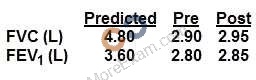
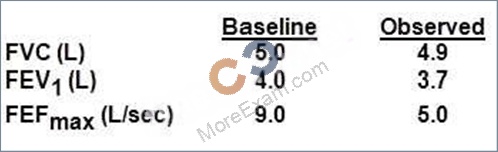
Question1: The following results were obtained from spirometry before and after a bronchodilator administration:

Which of the following is the correct interpretation of these data?

Question2: While reviewing exercise data, a pulmonary function technologist notes that the patient's anaerobic threshold occurred at 35% of the patient'sVO2MAX.This indicates the patient has

Question3: CORRECT TEXT
A pulmonary function technologist is reviewing results of a recent mechanical diffusion simulation using a 3-liter syringe. The test was conducted at a room temperature of 22 C.
The following BTPS results were reported:

Which of the following should the technologist do?

Question4: A pulmonary function laboratory routinely tests five subjects as biologic controls.
Acceptable instrument performance over time is indicated when measurements

Question5: Which of the following thresholds for a clinically significant change in lung function from the beginning to the end of a methacholine challenge test is significant?

Question6: At maximum exercise, a 24-year-old patient's heart rate is 150/min with a VO2of 750 mUmin. The calculated 02 pulse is most consistent with which of the following?

Question7: A patient with severe airflow limitation pants too rapidly (> 3 breaths/second) against a closed shutter in a body plethysmograph. Which of the following will occur?

Question8: When performing exercise testing on a biologic control, the measurements obtained should be compared with

Question9: A government agency requires that a pulmonary function technologist establish procedures to minimize the loss of laboratory data. Which of the following should be included in these procedures?
1. Continuous mirroring of hard drives
2. Storage of duplicate test data offsite
3. No Internet connections to the computer storing the database
4. Contracting with a third-party security company

Question10:
Which of the above patterns illustrates the effect of increasing temperature in the plethysmograph during airways resistance measurement?

Question11: While performing a quality control test on an open circuit nitrogen system, the volume of a 3-liter syringe is measured as 3.9 L.
Which of the following is the most probable explanation?

Question12: An arterial blood gas performed prior to exercise on a 45-year-old patient shows the following results:

A pulmonary function technologist should conclude that the patient's

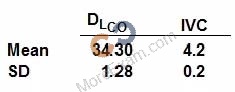
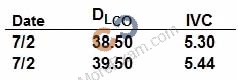
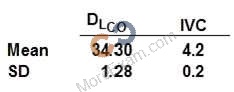
Question13: The following biologic control data ranges were established:

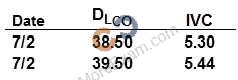
The following additional data were obtained when assessing the equipment:

Which of the following should a pulmonary function technologist do?

Question14: The following values are reported at maximum effort for a 50-year-old, 70-kg (154-lb) male with significant coronary artery disease during ergometer stress testing. Which of the following is most likely an error?

Question15: To check the reliability of a pulse oximeter reading, a pulmonary function technologist should

Question16: A physician orders smoking cessation counseling for a 60-year-old male with a new diagnosis of CHF and COPD. The patient has failed several attempts to quit smoking using nicotine gum. Which of the following should a pulmonary function technologist recommend?

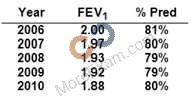
Question17: A 45-year-old female with sarcoidosis has pulmonary function tests annually. The following data have been recorded:

A pulmonary function technologist should conclude that

Question18: During an exercise study, the RER will equal the RQ only when the patient is at
Question19: During a cardiopulmonary stress test using breath-by-breath gas analysis, a pulmonary function technologist notices that the VO2 suddenly decreases. Which of the following may explain this change?
1. The patient has achieved anaerobic threshold.
2. The measurement of the expired gas volumes is inaccurate.
3. O2 analyzer "phase delay" has increased.
4. There is a leak in the tubing or mouthpiece.

Question20: The following biologic control data ranges were established:

The following additional data were obtained when assessing the equipment:

Which of the following should a pulmonary function technologist do?

Question21: To facilitate measurement of arterial oxygen content during an exercise (stress) test, a pulmonary function technologist should recommend

Question22: A polarographic oxygen analyzer used to measure expired gas in a metabolic system should always be calibrated with

Question23: The following data are obtained for a 60-year-old male undergoing an exercise (stress) test on an ergometer:

A pulmonary function technologist should

Question24: When performing quality control in a body plethysmograph using a 5-L isothermal bottle, theVTGat shutter closure are as follows:

A pulmonary function technologist should

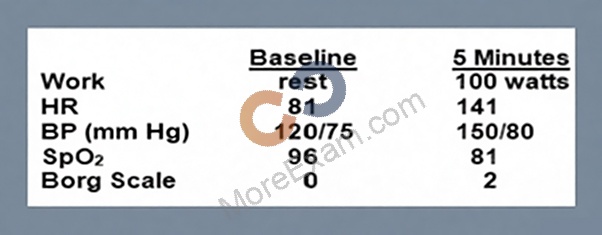
Question25: A 35-year-old healthy male is performing a maximal stress test as part of an annual physical. The following data are observed:

The patient denies any symptoms. Which of the following should a pulmonary function technologist do first?

Question26: During daily quality control procedures on an infrared CO2 analyzer, a pulmonary function technologist is unable to adjust the gain to the calibration gas concentration. Which of the following is the most likely explanation?

Question27: A patient has normal pulmonary and cardiac function. Which of the following is most likely when the patient reaches the anaerobic threshold during incremental stress testing?

Question28: During an exercise (stress) test, the minute ventilation to carbon dioxide production (Ve
/VCO2) ratio is 100. This measurement indicates

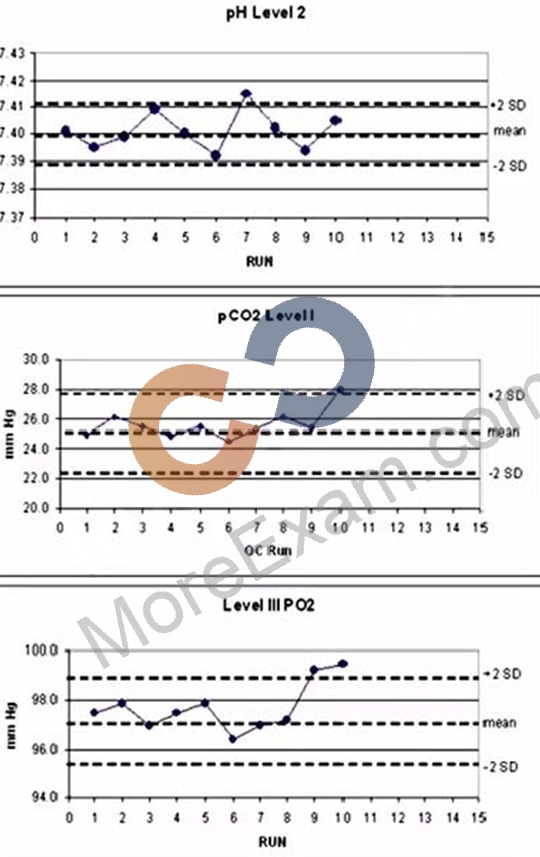
Question29: The following Levy-Jennings charts of control values are obtained:

Which of the following is the correct sequence of actions for a pulmonary function technologist to take?
1.Replace the oxygen electrode.
2.Check the temperature of the measuring chamber.
3.Run protein remover through the blood gas analyzer.
4.Replace theCO2electrode.

Question30: Which of the following may cause a reduction in end-tidal CO2?

Question31: A patient is performing a flow-volume loop. A pulmonary function technologist observes equal decreases in expiratory and inspiratory flows resulting in plateaus. Patient effort is satisfactory, and he follows instructions well. The technologist should expect the patient to have a

Question32: A patient has just finished a 6-minute walk test during which she stopped and rested by leaning against a wall several times, while catching her breath. Which of the following should a pulmonary function technologist do?

Question33: During an exercise study, a pulmonary function technologist notices the systolic blood pressure increased to
270 mm Hg using an automated cuff. Which of the following should the technologist do?

Question34: The following data were obtained from a bronchial challenge test:

APC20of 2 mg/mL was obtained the next day in another laboratory. Which of the following is the most likely explanation for these data?

Question35: A pulmonary function technologist is reviewing an asthma action plan. The patient takes a low-dose inhaled corticosteroid and a long-acting beta2-agonist twice daily. The patient's personal best peak flow is 600 L/min. Which of the following instructions should be given to the patient when the peak flow drops to 500 L/min?

Question36: The following results are obtained from an adult patient:

Which of the following is the best interpretation of these values?

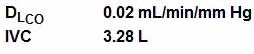
Question37: When selecting gas tanks for a DLcosimulator, which of the following expired CO gas concentrations will produce the highest simulated DLco?

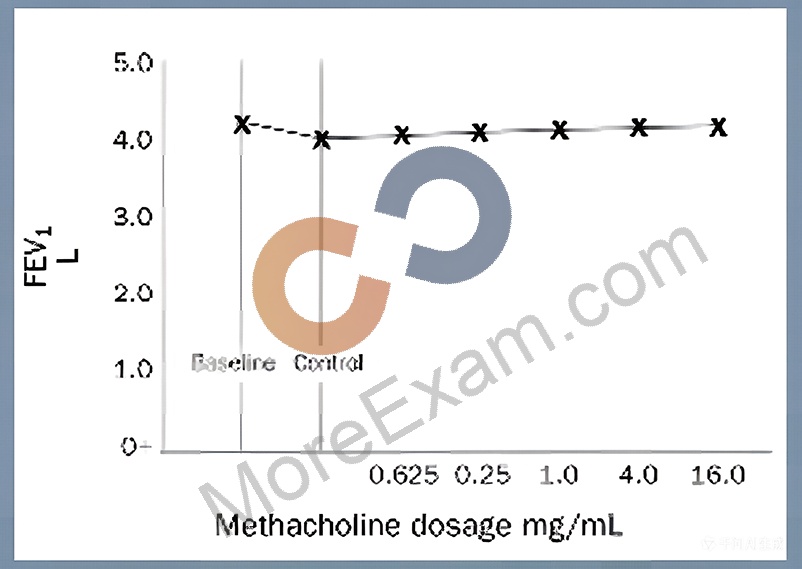
Question38: During a bronchial provocation study, a patient has the following spirometric values after a 0.25 mg/mL dose of methacholine:

Based on these results, a pulmonary function technologist should

Question39: A body plethysmograph box pressure transducer fails the electronic calibration check after multiple attempts. Which of the following should a pulmonary function technologist do?
1.Perform a biologic control test
2.Inspect the door seal.
3.Re-zero the box pressure transducer.
4.Perform a physical pressure calibration.

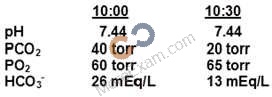
Question40: Results of two blood gas samples drawn from the same patient, 30 minutes apart, are shown below:

Which of the following is the most likely explanation for these differences?

Question41: While assessing a patient's expired gases at rest prior to exercise, a pulmonary function technologist calculates the RER as 0.6. Which of the following is the most likely explanation?

Question42: A patient's bronchial provocation test was interpreted as positive for hyperreactive airways. Considering changes from a pre-challenge baseline, all of the following are consistent with this interpretation EXCEPT a

Question43: The following data are obtained for a 60-year-old male undergoing an exercise (stress) test on an ergometer:

A pulmonary function technologist should

Question44: During a cardiopulmonary stress test using breath-by-breath gas analysis, a pulmonary function technologist notices that the VO2suddenly decreases. Which of the following may explain this change?
1.The patient has achieved anaerobic threshold.
2.The measurement of the expired gas volumes is inaccurate.
3.O2analyzer "phase delay" has increased.
4. There is a leak in the tubing or mouthpiece.

Question45: During an exercise study, the RER will equal the RQ only when the patient is at
Question46: A 9-year-old girl had an FVC of 2.35 L1 year ago. She was 122 cm (4 ft) tall and weighed 29.5 kg (65 lb). Her current height is 127 cm (4 ft 2 in), and her weight is 34 kg (75 lb). The current FVC measurement is 2.20 L.
The quality of both tests met ATS/ERS goals. A pulmonary function technologist should conclude the change is

Question47: A patient's vital capacity is slightly reduced, the FEWFVC is normal, and the uncorrected DLco is increased. Which of the following is the most likely diagnosis?

Question48: During an exercise study, a pulmonary function technologist notices the systolic blood pressure increased to 270 mm Hg using an automated cuff. Which of the following should the technologist do?

Question49: During a cardiopulmonary stress test using breath-by-breath gas analysis, a pulmonary function technologist notices that the VO2 suddenly decreases. Which of the following may explain this change?
1. The patient has achieved anaerobic threshold.
2. The measurement of the expired gas volumes is inaccurate.
3. O2 analyzer "phase delay" has increased.
4. There is a leak in the tubing or mouthpiece.

Question50: A patient's vital capacity is slightly reduced, the FEWFVC is normal, and the uncorrected DLco is increased.
Which of the following is the most likely diagnosis?

Question51: Which of the following is a suitable policy for following Standard Precautions in a pulmonary function laboratory?

Question52: At maximum exercise, a 24-year-old patient's heart rate is 150/min with a VO2 of 750 mUmin. The calculated
02 pulse is most consistent with which of the following?

Question53: A treadmill is set so that the belt rises 1 ft in a horizontal distance of 10 ft at 3 mph. The percent grade indicator should read

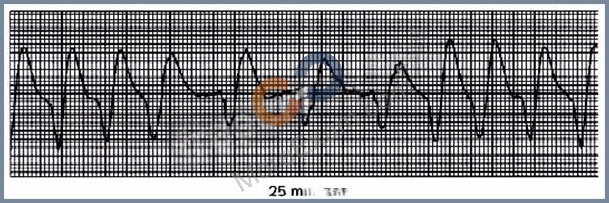
Question54:
The ECG above is recorded during the recovery phase immediately following termination of an ergo meter exercise study. A pulmonary function technologist should

Question55: While assessing a patient's expired gases at rest prior to exercise, a pulmonary function technologist calculates the RER as 0.6. Which of the following is the most likely explanation?

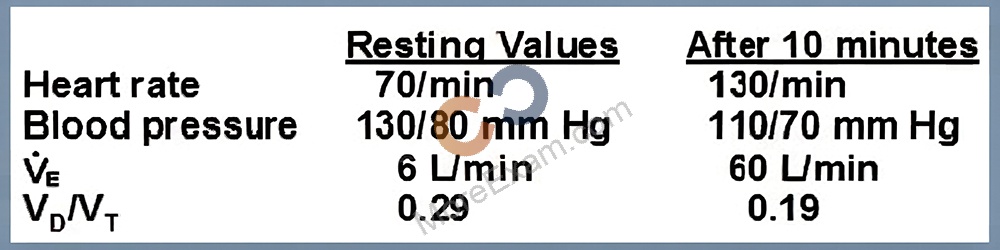
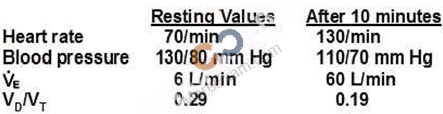
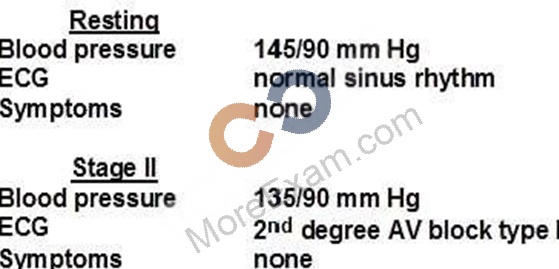
Question56: The following data are observed during an exercise test:

Which of the following should a pulmonary function technologist do?

Question57: Which of the following is correct regarding smoking cessation?
Question58: Prior to an exercise study, a pulmonary function technologist finds that the patient's RER is
1.13. Which of the following bestexplains this finding?

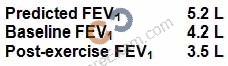
Question59: The following data are obtained after an exercise (stress) test for exercise-induced asthma:

Based on these data, the post-exercise FEVi represents a decrease of approximately

Question60: A physician orders smoking cessation counseling for a 60-year-old male with a new diagnosis of CHF and COPD. The patient has failed several attempts to quit smoking using nicotine gum. Which of the following should a pulmonary function technologist recommend?

Question61: During the calibration and set-up of the metabolic stress testing system for a patient breathing supplemental oxygen, which of the following gas concentrations will ensure accurate calibration of the system?

Question62: A patient who smokes three packs of cigarettes a day has a DLco Of 45% of predicted. The patient is referred for exercise (stress) testing. Which of the following should a pulmonary function technologist select to evaluate oxygenation?

Question63: An isothermal lung analog has the following specifications:
5-L glass bottle
2000 g of steel wool
Density of steel wool 5 g/cm3
Volume of connectors and bulb 100 mi-Repeated FRC measurements in the plethysmograph result in a volume of 5.5 L.
Which of the following should a pulmonary function technologist do?

Question64: A patient's bronchial provocation test was interpreted as positive for hyperreactive airways.
Considering changes from a pre-challenge baseline, all of the following are consistent with
this interpretation EXCEPT a

Question65: A patient has just finished a 6-minute walk test during which she stopped and rested by leaning against a wall several times, while catching her breath. Which of the following should a pulmonary function technologist do?

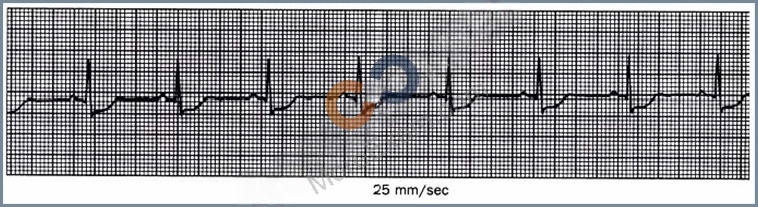
Question66: A 54-year-old male with a normal ECG at rest develops dyspnea during an exercise (stress) test, and the following ECG pattern is noted at 25 watts:

25 mm/sec A pulmonary function technologist should

Question67: Treadmill speed can be verified by

Question68: A pulmonary function technologist can calculate which of the following if values for pH, PaO2, SaO2, SvO2PvO2, VO2, and Hb areobtained?

Question69: When using a variable pressure plethysmograph, a leak in the door seal that develops subsequent to calibration will cause underestimation of

Question70: Which of the following thresholds for a clinically significant change in lung function from the beginning to the end of a methacholine challenge test is significant?

Question71: In which of the following patients would an end-tidal CO2most likely produce values that are inconsistent with PaCO2?

Question72: CORRECT TEXT
A pulmonary function technologist is asked to select gas concentrations to simulate pediatric patients' exhaled concentrations during a DLcosimulation. Which of the following FECO concentrations should the technologist select?

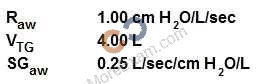
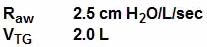
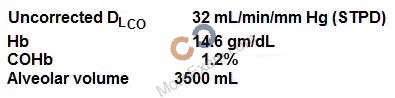
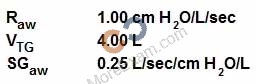
Question73: A subject has the following values reported:

WhatistheSGAW?

Question74: A helium dilution test has just been performed on a patient. The following results are obtained:
FRC 5.0 L
VC 4.0 L
ERV 1.5 L
TLC was calculated to be 6.0 L by plethysmography. From this information, a pulmonary function technologist should conclude that the patient

Question75: Prior to an exercise study, a pulmonary function technologist finds that the patient's RER is 1.13. Which of the following best explains this finding?

Question76: The following results are obtained from an adult male:

The corrected DLcovalue

Question77: A pulmonary function technologist is asked to select gas concentrations to simulate pediatric patients' exhaled concentrations during a DLco simulation. Which of the following FECO concentrations should the technologist select?

Question78: While assessing a patient's expired gases at rest prior to exercise, a pulmonary function technologist calculates the RER as 0.6. Which of the following is the most likely explanation?

Question79: The following results are obtained from an adult patient:

Which of the following is the best interpretation of these values?

Question80: Which of the following tracings represents an airways resistance maneuver performed with a slow breathing frequency?

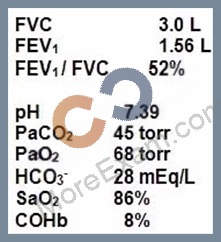
Question81: A 54-year-old male who smokes presents to the pulmonary laboratory for chronic cough and dyspnea on exertion. PFT and blood gas results show the following:

Which of the following should the pulmonary function technologist recommend?

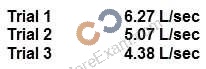
Question82: Successive peak flow measurements made with a peak flowmeter on a subject previously diagnosed as having asthma yield the following results:

Which of the following is the best explanation for these?

Question83: Which of the following is correct regarding smoking cessation?
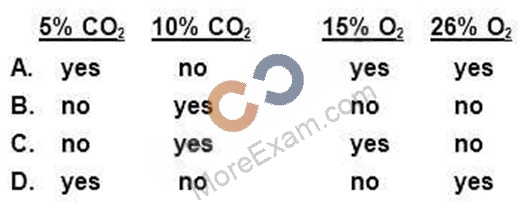
Question84: A 6-year-old child has a history of repeated episodes of wheezing and shortness of breath. A pulmonary function technologist has difficulty obtaining repeatable spirometry results. Which of the following tests should be performed next?